
Results


#1. With reference to which source are the facts that it was written in about fourth century A.D., contains short information and being the oldest chronicle of this country are relevant?
The Dipavamsa is the oldest surviving chronicle of Sri Lanka. It was compiled in the 4th century A.D. and is known for its relatively brief and less polished style compared to the later Mahavamsa. These characteristics—4th-century composition, brevity, and being the oldest chronicle—uniquely identify the Dipavamsa.
#2. A book which has been written by giving priority to the history of Buddhist dispensation (Sasana) of this country is
The Nikāya Samgrahaya is a 14th-century work that specifically details the history of the Buddhist Sangha (monastic order) in Sri Lanka. It focuses on the establishment of Buddhism, the formation of different monastic sects (nikāyas), doctrinal controversies, and the holding of councils. This makes it a primary source for the history of the Buddhist dispensation (Sasana), unlike the Rajavaliya which is a political chronicle.
#3. Select the statement that is not suitable in relevant to the inscriptions which are considered as an important historical source.
While inscriptions provide invaluable, contemporary snapshots of political, social, and economic life, they are sporadic and often focus on specific events like donations or royal decrees. They do not provide a continuous, narrative account of history. Therefore, it is impossible to construct an “unbroken political history” using only inscriptions; they must be used in conjunction with literary chronicles. The other statements are all valid uses of inscriptions.
#4. The caves situated at places such as Bulathsinhala and Kuruwita are important because they were
Caves in the wet zone lowlands like Batadombalena (near Kuruwita) and Fa-Hien Lena (near Bulathsinhala) are internationally famous archaeological sites that have yielded some of the earliest evidence of anatomically modern humans (Homo sapiens) in South Asia. The remains of “Balangoda Man,” along with stone tools and food remnants, provide crucial evidence for the lifestyle of prehistoric people in Sri Lanka.
#5. Out of the persons given below, what answer contains about the persons who arranged reports by visiting Sri Lanka and studying the informations? A – Megasthenes, C – Ptolemy, E – Robert Knox, B – Fa-Hien himi, D – Iban Batuta, F – Hsuan Tsang
Fa-Hien (B, c. 5th century), Ibn Battuta (D, 14th century), and Robert Knox (E, 17th century) are all famous for having visited Sri Lanka and written detailed firsthand accounts based on their extensive travels and observations within the island. Megasthenes (A) and Hsuan Tsang (F) wrote about India, not Sri Lanka. Ptolemy (C) was a geographer who wrote about Sri Lanka based on secondary reports, without visiting.
#6. Which of the following is useful to gain information about the clothes and fashions of royal women in Sri Lanka during the fifth century A.D.?
The Sigiriya frescoes, painted during the reign of King Kashyapa in the late 5th century A.D., are the most direct and detailed visual evidence for the attire of elite women of that specific period. They depict elaborate clothing, hairstyles, and jewelry, providing invaluable information on 5th-century fashion. The other options are either from different time periods (Tivanka, Dalada Maligava) or are not as specifically illustrative of fashion (excavated jewelry portions).
#7. An important incident of the proto-historic age of Sri Lanka is
The proto-historic period (or Iron Age) in Sri Lanka is characterized by the emergence of new technologies and cultural practices. Key among these is the first appearance of pottery, specifically the distinctive Black and Red Ware. The use of clay pots for storage, cooking, and burial rituals is a hallmark of this period, distinguishing it from the preceding pre-historic stone age. The activities in options 2, 3, and 4 are characteristic of the pre-historic age.
#8. An example which could be forwarded to prove the dwellers in this country before 3000 years ago knew the necessity of oxygen for the process of burning is
The discovery of wattle and daub (clay mixed with organic material, applied to a woven lattice) house fragments that have been hardened by fire (daub) at sites like Udaranchamadama indicates the inhabitants knew how to control fire to create durable building materials. Firing clay requires reaching high temperatures, a process that inherently demonstrates an understanding of how to manage airflow (oxygen) to sustain a hot fire. This is a more complex application of fire technology than just baking food (1) or simple pottery firing (2).
#9. From what era could evidence be found about the ritual of burying dead bodies digging out after decay, cleaning up the skull and painting it with brown stones red in colour?
This specific ritual, known as secondary burial, is a distinctive feature of the proto-historic (Iron Age) megalithic burial culture in Sri Lanka. At sites like Pomparippu and Ibbankatuwa, archaeologists have found large urns containing skeletal remains that were exhumed after initial burial, cleaned, sometimes painted with red ochre, and then re-interred.
#10. The opinion of the modern archaeologists is that the settlements in the early historical period in Sri Lanka expanded in the outer areas of the river valleys. Which river valley prove that opinion?
The Malvatu Oya valley is the cradle of Sri Lanka’s ancient civilization. The earliest major settlements, including the great capital city of Anuradhapura, are located along its banks. Archaeological surveys have revealed a dense concentration of early historic period settlements, characterized by village tanks and Brahmi inscriptions, throughout the Malvatu Oya basin, proving its central role in the expansion of early settlements.
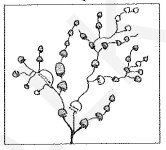
#11. The accompanying picture depicts a system of tanks. With reference to it answer the questions No. 11 and No. 12. : One of the aims of creating these systems of tanks would have been
The image depicts an ‘ellanga gammana’ or cascading tank system, which is a series of interconnected small and medium-sized tanks. The primary purpose of this entire system is to capture and store rainwater (conservation of water) that would otherwise run off. This stored water is then used for agriculture and domestic needs throughout the dry season. While it may also help with flood control (2) and soil erosion (4), its fundamental aim is water conservation.
#12. These systems of tanks could be seen abundantly in the
The cascading tank system shown in the picture is a unique adaptation to the environmental conditions of Sri Lanka’s Dry Zone. This region receives seasonal rainfall followed by long dry periods, making the storage and management of water essential for agriculture and human survival. These systems are the hallmark of the ancient hydraulic civilization of the Dry Zone.
#13. The ruler who is considered as one who constructed an anicut across a stream for the first time in the history of Sri Lanka was
According to the Mahavamsa, King Vasabha (67-111 A.D.) was a prolific builder of irrigation works. He is credited with constructing eleven reservoirs and, significantly, twelve canals. The construction of canals implies the building of anicuts (diversion dams) to divert water from streams into them, making him the earliest ruler explicitly associated with this technology in the chronicles.
#14. The park which is considered to be the distinctive urban park with regard to the planning, technology and in ancient Sri Lanka is
The gardens of Sigiriya are a world-renowned masterpiece of ancient landscape architecture. They are a unique and complex combination of symmetrical water gardens, boulder gardens, and terraced gardens, integrated with sophisticated hydraulic technology. Their distinctiveness, advanced planning, and technological brilliance make them the most outstanding example of an urban park in ancient Sri Lanka.
#15. In the inscriptions which include the information regarding the offerings to the temples several symbols have been used. Of them, what is meant by the illustration of the symbol swan?
In Buddhist art and symbolism, the swan (hamsa) is a potent symbol. It is believed that a swan can separate milk from water, representing the ability to distinguish good from bad, or truth from falsehood. This ability symbolizes discernment, wisdom, and ultimately, purity.
#16. The measurement which was used to indicate the distance of roads in the past was
A ‘gauwa’ (also ‘gavyuta’) was a standard ancient unit of linear measurement used to denote long distances, such as the distance between villages or along roads. It is frequently mentioned in chronicles and inscriptions in this context. A ‘viyatha’ is a shorter span, and ‘karisa’ is a measure of land area.
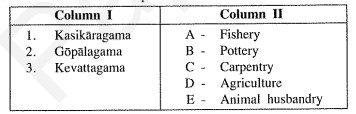
#17. The column I below includes some village settlements which were in Sri Lanka and the column II gives the main economic activities performed in them. Column I: 1. Kasikāragama, 2. Gõpālagama, 3. Kevattagama. Column II: A – Fishery, B – Pottery, C – Carpentry, D – Agriculture, E – Animal husbandry. When the column II is matched according to the column I what is the correct answer?
The names of the villages indicate their function: ‘Kasikāragama’ (1) means ‘agriculture village’, so it matches with D (Agriculture). ‘Gōpālagama’ (2) means ‘herdsmen’s village’, matching with E (Animal husbandry). ‘Kevattagama’ (3) means ‘fishermen’s village’, matching with A (Fishery). Therefore, the correct sequence of activities is D, E, A.
#18. The main factor that led Sri Lanka to be a multi-national, multi-religious as well as multi-cultural country was,
Sri Lanka’s strategic location at the center of the Indian Ocean sea routes has made it a nexus for international trade and interaction for over two millennia. This central position attracted a continuous flow of traders, migrants, invaders, and religious missions from India, Arabia, Southeast Asia, and Europe, resulting in the island’s diverse multi-national, multi-religious, and multi-cultural character.
#19. From among the kings and queens given below what is the answer which contains about the rulers belonged to the Polonnaruva Kingdom? : A – King Vankanāsika Tissa, B – Queen Kalyänavati, C – King Vasabha, D – King Niśśankamalla, E – King Mahasen, F – King Sahāsamalla
Queen Kalyānavati (B), King Niśśankamalla (D), and King Sahāsamalla (F) were all rulers during the Polonnaruva Kingdom period (late 12th – early 13th centuries). The other rulers listed (Vankanāsika Tissa, Vasabha, Mahasen) were from the earlier Anuradhapura Kingdom.
#20. The responsibility of seizing a hiding criminal in the ancient society were given to the
Ancient inscriptions and legal texts indicate that collective responsibility was a key principle of village administration. When a crime occurred, it was the collective responsibility of all the villagers to find and hand over the culprit. If they failed to do so, the entire village could be held liable and fined.
#21. The names used by a few kings before they came to power are given below from A to E. A – Prince Sapumal, C – Prince Tikiri, E – Prince Kannasāmi, B – Prince Muttusāmi, D – Prince Maha Asthāna. Study these and select the answer which contains in order the names used by Rājasimha I, Buvenekabāhu VI and Sri Vikrama Rājasimha.
Rajasiṃha I of Sitawaka was known as Prince Tikiri (C) before his coronation. Buvanekabāhu VI of Kotte was originally Prince Sapumal (A). Sri Vikrama Rajasiṃha, the last king of Kandy, was known as Prince Kannasāmi (E) before he was brought from South India to ascend the throne. Therefore, the correct sequence is C, A, E.
#22. The main feature that could be seen in the political field during the Gampola period is
The Gampola period (14th century) witnessed a significant syncretism of Buddhism and Hinduism. A distinct architectural feature of this era was the construction of temple complexes where a Buddhist image house was built adjacent to a devala dedicated to a Hindu deity (or a guardian deity of Hindu origin), reflecting the growing influence of Hinduism on the political and religious life of the kingdom.
#23. Select the incorrect statement with regard to the collapse of the Jaffna Kingdom.
This statement is incorrect. The Jaffna Kingdom offered strong and prolonged resistance to the Portuguese. Kings like Sankili I and Cankili II actively fought against them. Even after its final conquest in 1619, there were numerous rebellions against Portuguese rule, demonstrating that the majority of the population was not loyal to them. The other three statements are considered valid contributing factors to the kingdom’s eventual fall.
#24. Answer the questions 24 and 25 with reference to the information to the historical incidents given below: A – Defeating the Portuguese at the battle of Danture, B – Baptizing Kusumasana Devi in the name of Dona Kathirina, C – Inheritance of the kingship of the Kandyan Kingdom to the Nayakkar clan, D – Origin of Siamese sect in this country : State the correct historical sequence of the above incidents.
The correct chronological order is: B. Kusumasana Devi (Dona Kathirina) was baptized in the late 16th century. A. The Battle of Danture took place in 1594. C. The Nayakkar dynasty inherited the throne in 1739. D. The Siamese sect (Siyam Nikaya) was established in 1753. This sequence corresponds to B, A, C, D.
#25. Who is the king connected to the historical incident stated in letter C?
Incident C is the “Inheritance of the kingship of the Kandyan Kingdom to the Nayakkar clan.” This happened in 1739 when King Sri Vira Parakrama Narendrasimha died without an heir from his principal queen. The throne then passed to the queen’s brother from Madurai, who was crowned as Sri Vijaya Rajasimha, thus beginning the Nayakkar dynasty.

#26. Answer the questions 26 and 27 with reference to the information given in the following table from A to F. The cause that influenced: A – The tax policy of the government, B – Repentence of not having a king. The Leader: C – Keppotipola Disava, D – Gongalegoda Banda. The Governor: E – Lord Torrington, F – Sir Robert Brownrigg. : What answer includes the informations regarding the independence struggle of 1818?
The Great Rebellion of 1818 was led by Kandyan chiefs, most prominently Keppetipola Disava (C). The British Governor at the time was Sir Robert Brownrigg (F). While there were many causes, a key ideological element was the Kandyan belief in the necessity of having a legitimate king, leading them to rally behind a pretender; this can be linked to the concept in B (‘Repentence of not having a king’). Thus, B, C, and F are all relevant to the 1818 struggle.
#27. Answer the questions 26 and 27 with reference to the information given in the following table from A to F. The cause that influenced: A – The tax policy of the government, B – Repentence of not having a king. The Leader: C – Keppotipola Disava, D – Gongalegoda Banda. The Governor: E – Lord Torrington, F – Sir Robert Brownrigg. : What answer includes the informations regarding the independence struggle of 1848?
The Matale Rebellion of 1848 was primarily a popular uprising sparked by the harsh tax policies (A) imposed by the government of Governor Lord Torrington (E). The main leader of this rebellion was Gongalegoda Banda (D), who was proclaimed king by the rebels. Therefore, A, D, and E are the key elements connected to the 1848 struggle.
#28. Few pairs of statements with reference to the religious and cultural revival of Sri Lanka in the 19th century are given below. Out of them, what is the pair which is not-relevant?
While Sri Arumuga Navalar was a paramount figure in the Hindu revival, he was not the founder of the newspaper ‘Udayabhanu’ (Morning Sun). The first Tamil newspaper was ‘Udaya Tharakai’ (Morning Star), started by American missionaries. The other three pairs are correct: Olcott founded the Theosophical Society in Sri Lanka, Hikkaduwe Sri Sumangala founded the Vidyalankara Pirivena, and Siddi Lebbe was a key founder of Zahira College.
#29. Out of the following changes that took place in Sri Lanka due to the administration of the British, what is the answer which contains two cultural changes? A – Birth of a labour class, B – Mixing of western costumes, customs and tradition into the society of this country, C – Expansion of the western education, D – Birth of a labour group who works for the salary, E – Establishment of trade unions
Cultural changes refer to shifts in values, beliefs, customs, and social behaviors. The “Mixing of western costumes, customs and tradition” (B) is a direct cultural change. The “Expansion of the western education” (C) is also a profound cultural change, as it introduced new knowledge systems, languages (English), and values that significantly altered the society. The other options (A, D, E) refer to economic and social structural changes (the emergence of new classes and organizations) rather than cultural changes in this specific sense.
#30. Who was appointed as the first President of the Ceylon National Congress?
The Ceylon National Congress was formed in 1919 by amalgamating the Ceylon National Association and the Ceylon Reform League. Sir Ponnambalam Arunachalam, a key figure in the nationalist movement and a champion of unity between the Sinhalese and Tamils at the time, was elected as its first President.
#31. According to the constitution of 1978, what is the democratic system which could be followed in getting the people’s opinion directly on matters of national importance?
The 1978 Constitution introduced the referendum as a mechanism for direct democracy. It allows the government to, and in some cases requires it to, put questions of national importance directly to the people for a vote. This is the most direct way of obtaining the people’s opinion, as it bypasses representatives and consults the electorate itself.

#32. Answer the questions 32 and 33 with reference to A and B given below. A – Oath in the tennis court, B – Sarajevo incident. : Regarding the French Revolution,
The “Oath in the tennis court” (A) was a pivotal event in the early stages of the French Revolution in 1789. The “Sarajevo incident” (B), the assassination of Archduke Franz Ferdinand, was the trigger for World War I in 1914 and has no connection to the French Revolution. Therefore, A is correct and B is incorrect in the context of the French Revolution.
#33. Regarding the World War 1
The “Oath in the tennis court” (A) is related to the French Revolution, not World War I. The “Sarajevo incident” (B) was the immediate cause that triggered the start of World War I. Therefore, in the context of World War I, A is incorrect and B is correct.
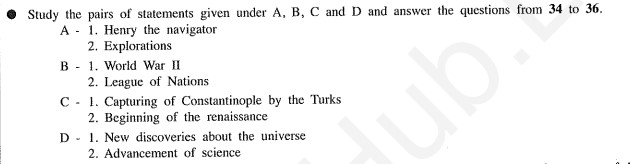
#34. Study the pairs of statements given under A, B, C and D and answer the questions from 34 to 36. A: 1. Henry the navigator, 2. Explorations. B: 1. World War II, 2. League of Nations. C: 1. Capturing of Constantinople by the Turks, 2. Beginning of the renaissance. D: 1. New discoveries about the universe, 2. Advancement of science. : What is the pair of statement that does not indicate the relationship between the first one and second one?
The League of Nations (B-2) was created after World War I with the aim of preventing future conflicts. World War II (B-1) broke out in 1939, signifying the failure of the League of Nations. Therefore, there is an inverse relationship; the occurrence of the first (WWII) demonstrates the failure of the second (League of Nations), unlike the other pairs where the first contributes to or causes the second.
#35. Study the pairs of statements given under A, B, C and D and answer the questions from 34 to 36. A: 1. Henry the navigator, 2. Explorations. B: 1. World War II, 2. League of Nations. C: 1. Capturing of Constantinople by the Turks, 2. Beginning of the renaissance. D: 1. New discoveries about the universe, 2. Advancement of science. : What is the pair of statement that does not indicate the relationship between the first one and second one?
The capturing of Constantinople by the Ottoman Turks in 1453 (C-1) is a key event often cited as a catalyst for the Renaissance (C-2). The fall of the city led to the migration of Greek scholars to Italy, bringing with them classical texts and knowledge that fueled the revival of learning. It also disrupted traditional trade routes, spurring exploration, another facet of the Renaissance. Thus, the first event necessitates or strongly encourages the development of the second.
#36. Some informations regarding the significant revolutions of the world are given below. With reference to those, answer the questions 37 and 38. A – Peace, land and food, B – States General Assembly, C – No representation, no tax, D – Attack on Bastille prison. : The theme of the Russian Revolution is
The slogan “Peace, land and food” (or “Peace, Land, and Bread”) (A) was the powerful and effective Bolshevik slogan during the 1917 Russian Revolution. It directly addressed the key grievances of the Russian people: the desire to end the disastrous involvement in World War I (Peace), the peasants’ demand for land redistribution (Land), and the widespread hunger in the cities (Bread/Food).

#37. Some informations regarding the significant revolutions of the world are given below. With reference to those, answer the questions 37 and 38. A – Peace, land and food, B – States General Assembly, C – No representation, no tax, D – Attack on Bastille prison. : An information regarding the independence struggle in America is
No taxation without representation was the central slogan and political principle of the American Revolution. The American colonists argued that the British Parliament had no right to impose taxes on them (like the Stamp Act) because they did not have elected representatives in that Parliament. This grievance was a primary cause of the struggle for independence.
#38. What is the institution of the United Nations regarding the following duties? • Appointing the Secretary General on the recommendation of the Security Council • Appointing Judges for the International Court of Justice • Admission of new members to the organization
According to the UN Charter, the General Assembly holds these key powers. It appoints the Secretary-General based on the Security Council’s recommendation, elects the judges of the ICJ (jointly with the Security Council), and makes the final decision on the admission of new member states to the organization.
#39. The South Asian Leader who took the priority in establishing an independent organization with the intention of being impartial either to American or Russian block was
Jawaharlal Nehru, the first Prime Minister of India, was a principal architect and a leading voice of the Non-Aligned Movement (NAM). He championed the idea of a “third path” for newly independent nations, advocating for them to remain impartial and not align with either the US-led Western bloc or the Soviet-led Eastern bloc during the Cold War. As the leader of India, he is the pre-eminent South Asian leader associated with this policy.
