
Results


#1. What is the text which has recorded the unbroken history of Sri Lanka?
The Mahavamsa, or “Great Chronicle,” is renowned for providing a continuous and comprehensive narrative of Sri Lankan history from a monarchical and Buddhist perspective. It is considered more detailed and coherent than the earlier Dipavamsa, thus establishing the tradition of an “unbroken history.”
#2. From among the following, who, although an invader, is considered to have led a just and law-abiding rule according to Mahavamsa?
The Mahavamsa, despite being a chronicle that glorifies the Sinhalese king Dutugemunu, famously praises his adversary, the Chola invader Elara, for ruling with great justice and impartiality for 44 years. It recounts stories of his fairness even towards the Buddhist faith, making him a unique figure in the text.
#3. What is the term used for deserted tank villages?
In ancient Sinhala inscriptions, the term ‘Parikitta gam’ is used to denote villages that have been abandoned or fallen into ruin, often due to the collapse of their irrigation tanks. Conversely, ‘Aparikkitta gam’ refers to villages that are inhabited and flourishing.
#4. From among the following, what was considered as the most important qualification to be a village chieftain?
In the hierarchical and caste-based society of ancient Sri Lanka, leadership positions, including that of a village chieftain (Gamika), were traditionally hereditary and tied to social status. Being a descendant of a family with high caste and traditional authority in the area was the most important qualification, as it commanded respect and legitimacy.
#5. The first ruler who is considered to have divided the country into provinces and appointed ministers for each of them was
According to the Mahavamsa, King Pandukabhaya was the great organizer of the early Anuradhapura kingdom. He is specifically credited with establishing the system of village boundaries (gam-sīmā) and dividing the country into administrative regions, appointing officials to govern them, which represents the first systematic division of the country.
#6. From among the following, one important step taken by Vijayabahu I to strengthen the economy of the country was
After liberating the country from Chola rule (which was a political act), King Vijayabahu I’s primary focus was on rebuilding the devastated nation. The cornerstone of the economy was agriculture, so his most important economic step was the restoration of the irrigation system, which involved repairing thousands of breached tanks and anicuts and commencing new constructions.
#7. A king who was raised to divinity because of his great contribution to economy was
King Mahasen constructed several massive reservoirs, most famously the Minneriya tank, which transformed agriculture in the region. Due to his immense contribution to the water-based economy and the prosperity it brought, he was deified after his death and worshipped as ‘Minneriya Deiyo’ (the God of Minneriya), a folk deity associated with water and agriculture.
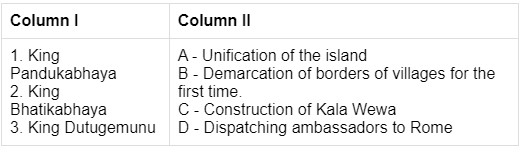
#8. The names of several kings are given in Column I and some points which are related to those kings are given in Column II. When Column II is matched according to the order of Column I, what is the correct answer?
1. King Pandukabhaya is credited with the first systematic demarcation of village borders (B). 2. King Bhatikabhaya is recorded in historical sources as having sent emissaries or ambassadors to Rome (D). 3. King Dutugemunu is celebrated as the hero who achieved the unification of the island by defeating Elara (A). The correct sequence is B, D, A.
#9. The reason to become Sri Lanka important in international commercial activities from ancient times is
Sri Lanka’s geographical position at the center of the Indian Ocean, directly on the ancient maritime silk route connecting the Roman West with the Chinese East, was the primary factor for its historical importance as a commercial hub. It was a natural and convenient meeting point and emporium for traders from all over the ancient world.
#10. From the following, what was the measure that had been adopted to prevent the tank bund from sinking?
The ‘Ralapanawa’ is a stone revetment (pitching) built on the upstream face of an earthen reservoir bund. Its function is to break the force of waves created by wind, preventing them from eroding the earthwork of the bund. This protection against wave erosion is crucial to prevent the bund from being weakened and eventually collapsing or “sinking”.
#11. Read carefully the statements from A to E and answer the questions 11 and 12.
A – Demonstration of an excellent knowledge in designing parks,
B – Use of moats and brick walls for protection,
C – Construction of the foundation similar to the methods used in modern concrete technology,
D – Demonstration of a sound knowledge of hygiene and health,
E – Discovery of evidence on the use of instruments of surgery.
: What is the answer which includes information on Sigiriya?
Sigiriya is a world heritage site renowned for its combination of a palace, fortress, and pleasure garden. It demonstrates an excellent knowledge of landscape architecture and park design (A) and is a formidable fortress protected by extensive moats and brick ramparts (B).
#12. Read carefully the statements from A to E and answer the questions 11 and 12.
A – Demonstration of an excellent knowledge in designing parks,
B – Use of moats and brick walls for protection,
C – Construction of the foundation similar to the methods used in modern concrete technology,
D – Demonstration of a sound knowledge of hygiene and health,
E – Discovery of evidence on the use of instruments of surgery.
: : What is the answer which includes information related to Alahana Pirivena?
The Alahana Pirivena in Polonnaruwa was a large monastic complex which included a hospital. Archaeological excavations at the site have unearthed sophisticated sanitation systems, demonstrating a sound knowledge of hygiene and health (D), as well as locally made surgical instruments, providing direct evidence of their use in surgery (E).
#13. What was the construction used in the past to keep the standard and the coolness of drinking water?
‘Andiya wells’ are a specific type of well construction where the shaft is lined with a series of terracotta (baked clay) rings stacked on top of each other. This lining prevents the sandy soil from collapsing into the well and, due to the insulating properties of the clay, helps to keep the water cool and clean, thereby maintaining its standard.
#14. What is the inscription in which the rules for the protection of the environment were included?
The slab inscription of King Mahinda IV found at Anuradhapura (often referring to the one at Mihintale) contains detailed regulations for the administration of the monastery. These rules cover the management of temple lands, forests, and water resources, including injunctions against felling certain trees, which constitute early forms of environmental protection laws.
#15. What is the main reason behind the inclusion of gruels (kenda) into their food by the Sri Lankans from early times?
Traditional Sri Lankan medicine and food culture place a strong emphasis on the nutritive and health-giving properties of food. Gruels (kenda), often prepared with rice, coconut milk, and various medicinal herbs (kola kenda), were consumed not just for sustenance but specifically because they were believed to enhance vitality, provide energy, and improve physical strength.
#16. The ruler who liberated the country from the invaders, Kalinga Magha and Chandrabanu was
Following the destructive invasion of Kalinga Magha, the task of liberation fell to the rulers of the Dambadeniya Kingdom. It was King Parakramabahu II who, over a long reign, successfully waged war against and expelled the forces of Kalinga Magha. He also repelled two subsequent invasions by the Malay ruler Chandrabhanu, thereby restoring sovereignty to the Sinhalese kingdom.
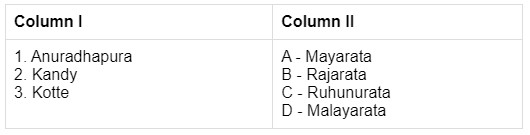
#17. Several kingdoms in Sri Lanka are given in Column I and several ancient administrative divisions are given in Column II. When Column II is matched according to the order of Column I what is the correct answer?
1. Anuradhapura was the capital of the ancient northern division, Rajarata (B). 2. Kandy was the capital of the kingdom in the central highlands, known as Malayarata (D). 3. Kotte was the capital of the kingdom in the western lowlands, which corresponds to the ancient division of Mayarata (A). The correct sequence is B, D, A.
#18. The king who built Kandy as an independent kingdom for the first time was
In the late 15th century, during the decline of the Kotte Kingdom, Sena Sammatha Wickramabahu established himself as the ruler of the Kandy region, effectively breaking away from Kotte’s suzerainty. He is therefore recognized as the founder of Kandy as an independent kingdom.
#19. Regarding the Renaissance in Europe.
A – Emergence of nation states,
B – Development of trade.
The Renaissance period (c. 14th-16th centuries) was characterized by significant political and economic changes. Politically, the power of feudal lords declined, and centralized monarchies grew stronger, leading to the emergence of early nation-states like France, Spain, and England (A is correct). Economically, this was an era of expanding exploration, banking, and a great development of trade (B is correct).
#20. Who invented the telescope?
While Dutch opticians like Hans Lippershey are credited with the initial invention of the telescope, it was Galileo Galilei who significantly improved the instrument and, most importantly, was the first to systematically use it for astronomical observation. His discoveries of the moons of Jupiter, the phases of Venus, and the craters on the Moon revolutionized science, and he is the figure historically synonymous with the telescope’s invention in a scientific context.
#21. What is the industry which developed as a result of its by-products such as paints, drugs, oil and fertilizer during the Industrial Revolution?
The process of heating coal to produce coke for the iron and steel industry yielded a crucial by-product: coal tar. The nascent chemical industry developed methods to distill this coal tar, creating a vast array of new products including aniline dyes (paints), pharmaceuticals (drugs like aspirin), oils, and chemical fertilizers. Thus, this development was a direct result of the coal industry.
#22. From among the following, what was a benefit gained by the introduction of the change of crops for cultivation during the Industrial Revolution?
The “change of crops” refers to the system of crop rotation, a key innovation of the British Agricultural Revolution. By rotating different types of crops (e.g., wheat, turnips, barley, clover) in the same field over successive seasons, farmers broke the life cycles of pests and pathogens that were specific to certain plants. This led to a significant reduction in the spread of plant diseases.
#23. From among the places given from A to D, what is the answer which includes the trading centres established by the British in India?
A – Madras,
C – Pondichery,
B – Bombay,
D – Chandranagar.
The British East India Company established its three most important trading centers, which grew into the capitals of their three Presidencies, in Madras (Fort St. George) (A), Bombay (B), and Calcutta. In contrast, Pondicherry (C) and Chandranagar (D) were the main trading posts of their rivals, the French.
#24. The Kandyan Kingdom was officially ceded to the British
The transfer of sovereignty of the Kandyan Kingdom to the British Crown was formalized through a legal treaty known as the Kandyan Convention (Udarata Givisuma). This document was signed on March 2, 1815, by the British Governor, Robert Brownrigg, and the principal chiefs of the kingdom, following the deposition of the king.
#25. The main reason for the English to pay their attention to the Trincomalee harbour in Sri Lanka was
During the global rivalry with France in the late 18th century, Britain’s primary strategic interest in the region was its Indian territories. The Trincomalee harbour, being a magnificent deep-water, all-weather port, was seen as essential for the Royal Navy to control the Bay of Bengal and protect the British possessions on the eastern coast of India from the French fleet.
#26. The most important factor which facilitated the British conquest of the Kandyan Kingdom was
While British military strength was an underlying factor, the immediate cause that facilitated the almost bloodless conquest of 1815 was internal dissent within the Kandyan Kingdom. King Sri Vikrama Rajasinha’s rule had become increasingly tyrannical, alienating powerful and influential chiefs like Ehelepola. This breakdown in the relationship between the king and his aristocratic subjects (nobles) led them to conspire with and assist the British.
#27. Who established the Zahira College in Colombo?
M.C. Siddhi Lebbe was a lawyer, educationist, and a key pioneer of the Muslim revivalist movement in 19th-century Sri Lanka. He was a principal advocate and driving force behind the establishment of modern education for Muslims, which culminated in the founding of Zahira College in Colombo in 1892.
#28. From among the following, what is the publication published by the Church Missionary Organisation?
Lanka Lokaya (The Lamp of Lanka) was an early Sinhala newspaper published by the Church Missionary Society (CMS) press in Kotte, starting in the mid-19th century. It was part of the missionary effort to use print media for evangelization and education.
#29. From among the following, what was the main objective of the agitation launched by the European entrepreneurs?
The European planters and merchants in 19th-century British Ceylon, represented by bodies like the Planters’ Association and the Chamber of Commerce, consistently agitated and lobbied the colonial government. Their main objective was to secure government investment in infrastructure, particularly the construction of roads and railways, which were essential for transporting their plantation products (coffee, then tea) from the hill country to the port of Colombo for export.
#30. Under the Donoughmore reforms, voting right was given,
The Donoughmore Constitution of 1931 was revolutionary for introducing universal adult franchise to Sri Lanka. The voting right was granted to all adult citizens, male and female, over the age of 21, without the property and literacy qualifications that had restricted the franchise previously. The voting age was later lowered to 18 in 1959.
#31. Who was the first president of the Ceylon National Congress?
When the Ceylon National Congress was founded in 1919, uniting various nationalist groups, the respected Tamil statesman Sir Ponnambalam Arunachalam was elected as its first president. His selection was intended to symbolize the unity between the Sinhalese and Tamil communities in the early phase of the independence movement.
#32. A field of subject which was not assigned to the Sri Lankan ministers in the State Council was
Under the Donoughmore Constitution, while seven Executive Committees were headed by elected Sri Lankan ministers, three key departments were run by non-elected British “Officers of State.” These were the Chief Secretary, the Legal Secretary, and the Financial Secretary. Therefore, financial matters were kept under direct British control and not assigned to a Sri Lankan minister.
#33. From among the following, what is the area in Sri Lanka which was not suitable for tea cultivation?
Tea cultivation requires a cool climate and high, consistent rainfall. The Dry Zone of Sri Lanka is characterized by low annual rainfall, high temperatures, and long periods of drought, making it environmentally completely unsuitable for growing tea. The other three regions are all major tea-producing areas.
#34. What is the main reason which led to the failure of cinchona cultivation in this country?
Cinchona was cultivated for its bark, from which the anti-malarial drug quinine was extracted. However, the development of cheaper quinine production methods from the bark of Javanese cinchona led to a global price collapse. This limited demand at a profitable price made Sri Lankan cinchona cultivation economically unviable, leading to its failure.
#35. Answer the questions 35 and 36 with reference to the information given from A to D.
A – Appointment of the Judicial Service Commission for the protection of the independence of the judiciary,
B – Power of appointing the cabinet of ministers was vested with the President,
C – Termination of constitutional links with the British empire,
D – Prime Minister was the head of the cabinet of ministers.
: What is the answer which includes information related to the Constitution of 1972?
The First Republican Constitution of 1972 made Sri Lanka an independent republic, thereby terminating the country’s status as a dominion and severing all constitutional links with the British Empire and monarch (C). Under this constitution’s parliamentary system, the Prime Minister was the head of government and the head of the cabinet of ministers (D).
#36. Answer the questions 35 and 36 with reference to the information given from A to D.
A – Appointment of the Judicial Service Commission for the protection of the independence of the judiciary,
B – Power of appointing the cabinet of ministers was vested with the President,
C – Termination of constitutional links with the British empire,
D – Prime Minister was the head of the cabinet of ministers.
: What is the answer which includes information related to the Constitution of 1978?
The Second Republican Constitution of 1978 created a powerful Executive Presidency. Under this system, the power to appoint the cabinet of ministers was vested in the President (B). The constitution also provided for the appointment of an independent Judicial Service Commission to protect the independence of the judiciary (A).
#37. Answer the question 37 with reference to the statements in A and B.,
A – Boston Tea Party,
B – Attack on the Bastille.
: Regarding the French Revolution
The Boston Tea Party (A) was a key protest event in the lead-up to the American Revolution. The Attack on the Bastille (B) was a pivotal event at the beginning of the French Revolution. Therefore, with regard to the French Revolution, statement A is incorrect, and statement B is correct.
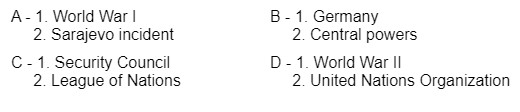
#38. Couples of statements are given under A, B, C and D. Examine the relationship between the statements given as 1 and 2 and answer the questions from 38 to 40.
: What is the couple which does not indicate a relationship between the first and the second?
The Security Council (1) is a principal organ of the United Nations. The League of Nations (2) was a separate, earlier international organization that ceased to exist before the UN was created. While the Security Council’s role is analogous to the old League Council’s, they are parts of two different entities, so there is no direct relationship in the way presented in the other pairs.
#39. Couples of statements are given under A, B, C and D. Examine the relationship between the statements given as 1 and 2 and answer the questions from 38 to 40.
: What is the couple which indicates that the 1st was caused by the 2nd?
The assassination of Archduke Franz Ferdinand of Austria-Hungary in Sarajevo (the Sarajevo incident, 2) was the immediate trigger or casus belli that set off the chain of events leading to the outbreak of World War I (1).
#40. Couples of statements are given under A, B, C and D. Examine the relationship between the statements given as 1 and 2 and answer the questions from 38 to 40.
: What is the couple which indicates that the 2nd emerged as a result of the 1st?
The United Nations Organization (2) was established in 1945. Its creation was a direct result of the devastation and failures of the international system that led to World War II (1). The victorious Allied powers designed the UN to be a more effective successor to the League of Nations to prevent future global conflicts.
