
Results


#1. Mahāvamsa is specific because of
While the Mahavamsa is trustworthy (4), was recorded relatively contemporaneously (2), and is a very old chronicle (though not the oldest, which is the Dipavamsa), its most specific and defining characteristic is its nature as a continuous, detailed narrative that intertwines both political history (dynasties, wars, kings) and religious history (the story of Buddhism in Sri Lanka). This comprehensive, continuous narrative is its key feature.
#2. In archaeological excavations, Chinese, Roman, Arabic and Indian coins have been found from various places of Sri Lanka. The most important fact revealed from these, is that
The discovery of coins from such a wide array of foreign civilizations (China, Rome, Arabia, India) provides direct, tangible evidence that Sri Lanka was engaged in long-distance trade with these regions. While it implies a developed economy (1) and the use of coins (2), the most direct and important conclusion is the existence of these extensive foreign trade relations.
#3. In connection with what period of following, are the sources such as Sandesha Kävya, Prasasti Kävya and Hatan Kāvya important in studying the history of Sri Lanka?
Sandesha (messenger poems), Prasasti (eulogies of kings), and Hatan (war poems) were literary genres that flourished particularly during the Kotte and subsequent Kandyan periods. They are vital sources for understanding the political events, social life, and cultural ethos of the late medieval kingdoms, especially from the 15th century onwards, which covers the Kotte to Kandy transition.
#4. The symbol ‘sun-moon’ has been used in the inscriptions to illustrate
In ancient Sri Lankan inscriptions, particularly on boundary stones (attani kanu), the symbols of the sun and moon are frequently carved. This imagery signifies permanence and endurance, conveying the message that the grant or decree inscribed on the stone should last “as long as the sun and moon exist.” It therefore symbolizes stability and perpetuity.
#5. We should protect our artifacts because they are
While artifacts are important for tourism (2), can be religious creations (3), and show past talents (4), their most fundamental value is that they serve as tangible evidence and expressions of Sri Lanka’s unique and evolving cultural identity. They are physical links to the nation’s history, beliefs, and artistic traditions, making their protection essential for preserving national identity.
#6. The place which is considered as the oldest place where the information of the pre-historic man has been found, is
Pahiyangala Cave (also known as Fa-Hien Lena) has yielded some of the earliest skeletal evidence of anatomically modern humans in South Asia, with human remains dated to as early as 48,000 years ago. This makes it one of the oldest and most significant pre-historic sites in Sri Lanka for understanding early human occupation. While Batadomba lena (1) and Beli lena (2) are also very important and ancient sites, Pahiyangala currently holds the distinction for the oldest human remains found.
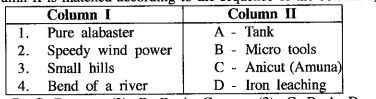
#7. The column I below has some connection with the technological creations given in the column II. When the column II is matched according to the sequence of the column I, what is the correct answer? Column I: 1. Pure alabaster, 2. Speedy wind power, 3. Small hills, 4. Bend of a river. Column II: A – Tank, B – Micro tools, C – Anicut (Amuna), D – Iron leaching.
Matching the items: 1. Pure alabaster is a feature of Micro tools (B) found from the pre-historic period. 2. Speedy wind power is utilized in Iron leaching (D) using monsoon winds. 3. Small hills were often used as the bund for a Tank (A). 4. A bend of a river is the ideal location to construct an Anicut (C). So the correct sequence is B, D, A, C.
#8. It is considered that the expansion of settlements connected with the small tanks system were begun outside the river valleys of the dry zone of Sri Lanka in the
The development of small village tank (wewa) systems is a hallmark of the early historic period (c. 3rd century BCE onwards). These tanks allowed settlements to expand away from the immediate riverbanks into the wider plains of the Dry Zone, enabling the spread of agriculture and population. This technological innovation defines the settlement pattern of this era.
#9. Who was in charge of the small tank systems?
The ‘Gamika’ (village leader) or ‘Gamasabhā’ (village council) was responsible for the local administration of the village, which included the maintenance and management of the village tank (gam-wewa) and the distribution of its water. This was a crucial function at the village level.
#10. One who constructed a full fledged capital for an organizational centralized administration was
According to the Mahavamsa, King Pandukabhaya (4th century BCE) was the ruler who truly established Anuradhapura as a well-organized and centralized capital city. He is credited with formally laying out the city, establishing the village boundary system (gam-simā), constructing major tanks like the Abhaya Wewa, and creating positions for civic administration. The others were earlier, less developed settlements or figures.
#11. A good example which could be given to show that special consideration has been taken with regard to the waste management in the architectural creations of the past is
The Alahana Pirivena in Polonnaruwa was a large monastic complex that also served as a hospital. Archaeological excavations have revealed a highly sophisticated and well-planned system of sanitation, including interconnected terracotta pipelines for drainage, soakage pits, and toilets. This demonstrates a clear and advanced consideration for waste management in its design.
#12. There are evidence to show that there were three harvests of cultivation in ancient Sri Lanka. The decision of cultivating the third harvest was taken on the
The main cultivation seasons (Maha and Yala) were based on the monsoons. A third harvest, known as ‘apitalla’, was only possible in certain areas and in certain years. The decision to undertake this extra harvest would have depended entirely on the availability of sufficient water in the reservoirs, i.e., the “possibility of receiving water,” either from late rains or ample storage.
#13. The name used by the Arabs to describe Sri Lanka was
Arab and Persian traders, who were frequent visitors to the island for centuries, referred to Sri Lanka as ‘Serendib’. This name is the origin of the English word “serendipity,” meaning a fortunate discovery by chance, reflecting the pleasant surprises they found on the island. Taprobrane was Greek/Roman, Tambapanni was an ancient local name, and Seylan (from which Ceylon is derived) has a later, European origin.
#14. During the Polonnaruva period the name ‘Gauta Pillars’ (Gauto Kanu) was used to show
The ‘Gauta Pillars’ or ‘Gavu Kanu’ are ancient milestones. However, during the Polonnaruwa period, a specific type of inscribed pillar was erected by King Nissankamalla to demarcate the boundaries of immunities or sanctuaries (Abhaya Bhūmi) granted to certain temple lands. These pillars declared that officials were not to enter these areas to collect taxes or arrest criminals.
#15. Out of the historical events given under following A, B, C and D, what is the answer which contain the event that may not be known by a person who lived during the period of the invasion of Kalinga Māgha?
A – Arrival of the Arab tourist Iban Bhatuta to Sri Lanka,
B – Construction of the Ruvanväli stupa,
C – Selecting Sigiriya by King Kāsyapa I as his administrative centre,
D – Ruling Jaffna by prince Sapumal for a certain period
The invasion of Kalinga Magha occurred in 1215 A.D. A person living at that time would have known about past events like the construction of the Ruvanvali stupa (B, 2nd century BCE) and the reign of Kasyapa at Sigiriya (C, 5th century CE). However, they could not have known about future events. The arrival of Ibn Battuta (A, 14th century) and the rule of Prince Sapumal in Jaffna (D, 15th century) both happened centuries after Kalinga Magha’s invasion. Therefore, A and D are the correct answers.
#16. An example to show that in the architectural creations which were constructed to bear a large weight, a method similar to the modern concrete technology has been used, is seen in
Excavations of the foundation of the massive Ruwanwelisaya stupa revealed that the ancient engineers had prepared the ground by crushing rock, mixing it with clay, and compacting it in layers using elephants. This process of creating a strong, consolidated artificial base to bear an immense load is conceptually similar to the principles behind modern concrete foundations.
#17. The best example to give for woman’s contribution to the confirmation of the inheritance of kingship in Sri Lanka is the marriage of
Vimaladharmasuriya I was a chieftain who seized power in Kandy. To legitimize his rule and establish a claim to the traditional royal lineage, he married Dona Catherina (Kusumasana Devi), who was the last surviving heir of the previous Kandyan royal dynasty. This marriage was a crucial political act that confirmed his right to the throne in the eyes of the Kandyan aristocracy and people.
#18. Which of the following ruling period mentions the invasion of a Chinese army to this country under the General Cheng-Ho?
The famous Chinese admiral Zheng He (Cheng-Ho) led several expeditions into the Indian Ocean in the early 15th century. During his third voyage (1409-1411), he intervened in the politics of the Kotte Kingdom. He captured the Kotte ruler, Vira Alakesvara, and took him back to China. This event took place during the Kotte period.
#19. For what trade commodity did the European nations involve in a hard competition to get from Sri Lanka ?
From the arrival of the Portuguese, followed by the Dutch and then the British, the most prized commodity and the primary driver of their economic and political interest in Sri Lanka was cinnamon. Control over the cinnamon trade was a source of immense profit, leading to intense competition and conflict among the European powers for control of the island’s maritime regions where it grew.
#20. Among the rulers given from A – F in the following, which answer contain about the rulers who followed a counteraction policy against the Portuguese?
A – Don Juan Dharmapala,
B – Edirmanna Singham,
C – Sankili,
D – Rājasimha I,
E – Bhuvanekabāhu VII,
F – Varodayan
Sankili I of Jaffna (C) and Rajasimha I of Sitawaka (D) were two of the most formidable and consistent opponents of the Portuguese in the 16th century. Both rulers actively and militarily pursued a “counteraction policy,” waging numerous wars and forming alliances to resist Portuguese expansion and influence in Sri Lanka. Don Juan Dharmapala (A) was a Portuguese puppet, and Bhuvanekabahu VII (E) was his father who tried to use the Portuguese.
#21. Few features connected to the constitutional reforms during the British administration in Sri Lanka are given below. What is the answer which states the historical sequence of it?
A – Provincial representative system,
B – Legislative and Executive councils,
C – Senate,
D – Universal Franchise
The correct historical sequence of these constitutional features is: B. Legislative and Executive Councils (Colebrooke-Cameron, 1833). D. Universal Franchise (Donoughmore, 1931). A. Provincial representative system (Manning, 1920s, but this is a general term, territorial representation became key here). C. Senate (Soulbury, 1947). The options provided are slightly problematic. However, the most logical progression of major reforms is: Legislative Councils (B), then Universal Franchise (D), then a Provincial/Territorial system as a development (A), and finally the Senate (C). So B, D, A, C is the best fit.
#22. Answer the questions 22 and 23 with reference to the informations given below from A to E.
A – Imposing of new taxes,
B – Collecting taxes by local officers,
C – Changing the posts of the aristocratic leaders,
D – Ordering to pay the taxes in cash,
E – Re-establishment of the Dutch court system. : What is the answer which contains the causes for the revolt in the maritime provinces against the English Trade Company in 1797 A.D?
The 1797 rebellion against the early British administration was sparked by changes to the existing tax system. The British imposed new taxes (A) such as a tax on coconut trees and, crucially, ordered that all taxes, which were traditionally paid in kind (as a share of the crop), must now be paid in cash (D). This created immense hardship for the peasantry and was a direct cause of the revolt.
#23. Answer the questions 22 and 23 with reference to the informations given below from A to E.
A – Imposing of new taxes,
B – Collecting taxes by local officers,
C – Changing the posts of the aristocratic leaders,
D – Ordering to pay the taxes in cash,
E – Re-establishment of the Dutch court system. : What is the answer which contains the proposals of the Meuron Commission?
The De Meuron Commission was appointed to recommend reforms after the 1797 revolt. Its key proposals were aimed at placating the local populace. These included abolishing the requirement to pay tax in cash, restoring the traditional service tenure system, and re-establishing the Dutch-era court system (E). It also recommended that tax collection be done by local headmen (B), not the often corrupt dubashes from India. Therefore, B and E were key proposals.
#24. Answer the questions 24 to 26 with reference to the statements given below from A to F.
A – Beginning of the ‘Muslim Neisan’ newspaper,
B – Establishment of the Colombo Theosophical Society (Parama Vigñanartha Movement),
C – Beginning of the Colombo Sahira College,
D – Beginning of the newspaper ‘Udayabhanu’,
E – Taking action to declare the Vesak full moon day as a holiday,
F – Beginning of the Shivangala Vidyalaya.
: What is the answer which consists of factors regarding Sir Henry Steel Olcott?
Colonel Henry Steel Olcott was a key figure in the Buddhist revival. He co-founded the Theosophical Society and established its Colombo branch (B). A major achievement of his campaigning was persuading the British colonial government to declare the Vesak full moon day a public holiday (E).
#25. Answer the questions 24 to 26 with reference to the statements given below from A to F.
A – Beginning of the ‘Muslim Neisan’ newspaper,
B – Establishment of the Colombo Theosophical Society (Parama Vigñanartha Movement),
C – Beginning of the Colombo Sahira College,
D – Beginning of the newspaper ‘Udayabhanu’,
E – Taking action to declare the Vesak full moon day as a holiday,
F – Beginning of the Shivangala Vidyalaya.
: What is the answer which includes facts regarding Mr. Siddi Lebbe?
M. C. Siddi Lebbe was a pioneer of the Muslim revival and modern education movement in Sri Lanka. He founded the first Muslim newspaper, ‘Muslim Nesan’ (A), to voice the community’s views. He was also a principal figure in the campaign that led to the establishment of Zahira College in Colombo (C), the premier Muslim educational institution.
#26. Answer the questions 24 to 26 with reference to the statements given below from A to F.
A – Beginning of the ‘Muslim Neisan’ newspaper,
B – Establishment of the Colombo Theosophical Society (Parama Vigñanartha Movement),
C – Beginning of the Colombo Sahira College,
D – Beginning of the newspaper ‘Udayabhanu’,
E – Taking action to declare the Vesak full moon day as a holiday,
F – Beginning of the Shivangala Vidyalaya.
: What is the answer which includes facts regarding Arumuga Navalar?
Arumuga Navalar was the foremost figure of the 19th-century Hindu (Saivite) revival in Jaffna. He was a great scholar and educator who worked to purify Saivism. He established numerous schools to teach Saivite principles, the most famous being the Saiva Prakasa Vidyasala or ‘Shivangala Vidyalaya’ (F). While he was a prolific writer and publisher, the newspaper ‘Udayabhanu’ (D) is not directly associated with him; he did, however, have his own printing press. The options are slightly flawed, but F is a definite and central achievement of Navalar, making D and F the most plausible intended answer.
#27. What affects to emerge three social classes as capitalist, labour and middle?
The Industrial Revolution fundamentally restructured society’s economic base. It created the owners of industrial capital (the capitalist class) and the wage-earning factory workers (the labour class). It also created a new ‘middle class’ of professionals, managers, engineers, clerks, and merchants who were neither owners of big capital nor manual labourers. This tripartite class structure is a direct outcome of industrialization.
#28. According to the constitution of 1978, when the fundamental rights and comprehensive freedom of a citizen is violated, a person should forward a petition to
The 1978 Constitution of Sri Lanka grants the Supreme Court sole and exclusive jurisdiction to hear and determine any question relating to the infringement or imminent infringement of a fundamental right by executive or administrative action. A citizen whose rights have been violated can directly petition the Supreme Court for relief.
#29. What can be regarded as an occasion in practising the direct democracy?
Direct democracy is a system where citizens vote directly on policy initiatives, rather than through their elected representatives. Holding a referendum is the classic example of direct democracy in modern states, as it allows the entire electorate to make a direct decision on a specific issue. All other options involve representative democracy or influencing it.
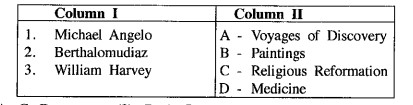
#30. Column I below gives the persons who were popularized during the Renaissance and the column II indicates the fields in which they became popularized. What is the correct answer when column II is matched according to the column I ? Column I: 1. Michael Angelo, 2. Berthalomudiaz, 3. William Harvey. Column II: A – Voyages of Discovery, B – Paintings, C – Religious Reformation, D – Medicine.
Matching the persons to their fields: 1. Michelangelo was a famous painter and sculptor (B). 2. Bartolomeu Dias was a Portuguese explorer famous for his voyages of discovery (A). 3. William Harvey was an English physician who made seminal contributions to medicine by describing the circulation of blood (D). The correct sequence is B, A, D.
#31. The first ruler who ventured with the aim of establishing a German Empire was
Otto von Bismarck, as the Minister President of Prussia, was the political mastermind behind the unification of Germany. Through a series of calculated wars and shrewd diplomacy, he engineered the creation of the German Empire, which was proclaimed in 1871 with the Prussian King, Wilhelm I (not Wilhelm II), as its Emperor. Bismarck was the architect of the empire.
#32. Study the pairs of statements/words given under A, B, C and D and answer the questions from 32 to 34.
A: 1. League of the Nations, 2. United Nations Organization.
B: 1. World Peace, 2. Economic sanctions.
C: 1. World War II, 2. Israel.
D: 1. Environmental pollution, 2. Industrialization.
: What is the pair of statement/pair of words which indicate that the development of the second one helps to the development of the first one?
The process of Industrialization (D-2) involves large-scale manufacturing, burning of fossil fuels, and generation of waste, which are major causes of Environmental pollution (D-1). Therefore, the development of the second (Industrialization) directly contributes to the development of the first (Pollution).
#33. Study the pairs of statements/words given under A, B, C and D and answer the questions from 32 to 34.
A: 1. League of the Nations, 2. United Nations Organization.
B: 1. World Peace, 2. Economic sanctions.
C: 1. World War II, 2. Israel.
D: 1. Environmental pollution, 2. Industrialization.
: What is the pair of statements/pair of words which point out that the unsuccessfulness of the first one was the cause for the beginning of the second one?
The League of Nations (A-1) was established after World War I to prevent future wars but ultimately failed to do so, as evidenced by the outbreak of World War II. The United Nations Organization (A-2) was established in 1945, after WWII, as a successor organization, learning from the failures of the League. Thus, the unsuccessfulness of the first (League) was a direct cause for the creation of the second (UN).
#34. Study the pairs of statements/words given under A, B, C and D and answer the questions from 32 to 34.
A: 1. League of the Nations, 2. United Nations Organization.
B: 1. World Peace, 2. Economic sanctions.
C: 1. World War II, 2. Israel.
D: 1. Environmental pollution, 2. Industrialization.
: What is the pair of statements/pair of words which indicates that the second one was the result of the first one?
World War II (C-1) included the Holocaust, the systematic genocide of European Jews by Nazi Germany. The international sympathy and political momentum generated in the aftermath of this tragedy were crucial factors leading to the United Nations’ approval of the Partition Plan for Palestine and the subsequent declaration of the State of Israel (C-2) in 1948.
#35. The objective of introducing the Marshall Plan after the World War II was
The Marshall Plan (officially the European Recovery Program) was a U.S. initiative to provide massive economic aid to Western European countries after the devastation of World War II. Its primary objective was to rebuild their economies, restore infrastructure, and prevent the spread of communism by alleviating economic hardship.
#36. The despotic ruler (dictator) who used the armed soldiers named ‘Black Shirt Army’ to destroy those who were against the Fascism was
Benito Mussolini, the founder of Italian Fascism, created a paramilitary wing for his party known as the ‘Blackshirts’ (Squadristi). This armed militia was instrumental in his rise to power, using violence and intimidation to attack and destroy political opponents, such as socialists, communists, and trade unionists.
#37. Answer the questions 37 and 38 with reference to the informations given in A and B.
A – Boston Tea Party,
B – Attack on the Pearl Harbour
: With reference to the freedom struggle of America
The Boston Tea Party (A) was a key act of protest by American colonists in 1773 against British taxation and was a major event leading to the American Revolutionary War (Freedom Struggle of America). The attack on Pearl Harbor (B) was a Japanese attack on the US in 1941, which brought the US into World War II and is unrelated to the American Revolution. Thus, A is correct and B is incorrect.
#38. Answer the questions 37 and 38 with reference to the informations given in A and B.
A – Boston Tea Party,
B – Attack on the Pearl Harbour
: With regard to the World War II
The Boston Tea Party (A) occurred in the 18th century and is related to the American Revolution, not World War II. The attack on Pearl Harbor (B) was the event that directly caused the United States to enter World War II in 1941. Therefore, A is incorrect and B is correct in the context of World War II.
#39. What is the name of the theory that acts tactfully without mediating to warfare for the success of their own political block?
The Cold War was a period of geopolitical tension between the United States and the Soviet Union and their respective allies. It was characterized by an intense rivalry that was “fought” through proxy wars, espionage, propaganda, and an arms race, but without direct large-scale fighting between the two superpowers. This “acting tactfully without mediating to [direct] warfare” to advance one’s political bloc is the definition of the Cold War.
#40. Who was the Yugoslavian President who worked as a pioneering leader in establishing the Non-Aligned Movement?
Marshal Josip Broz Tito, the President of Yugoslavia, was one of the three principal founders of the Non-Aligned Movement (NAM), along with Nehru of India and Nasser of Egypt. Tito hosted the first NAM Summit in Belgrade in 1961 and was a key ideological force in shaping the movement’s policy of independence from the major Cold War power blocs.
