
Results


#1. With regard to what subject area that numismatic is studied?
Numismatics is the scientific study or collection of currency, including coins, tokens, paper money, and related objects. Therefore, it is the study of old coins.
#2. Regarding on what objective that most of the local literary sources which are important to study the history from Anuradhapura period to the beginning of the Kõtte period were written?
Most of the major chronicles and literary works from this long period, such as the Dipavamsa, Mahavamsa, and various commentaries, were written by Buddhist monks. Their primary objective was to record the history of Buddhism (the Sasana) in Sri Lanka, its protection by kings, and the flourishing of the faith. Political and social events were included primarily as a backdrop to this religious narrative.
#3. To what kind of settlements that ‘Minihagalkanda’, which is considered, to be a settlement of the pre-historic man is belong?
Minihagalkanda, located in the modern Yala National Park, is a pre-historic site found on the southern coast of Sri Lanka. Archaeological evidence, such as microlithic stone tools and faunal remains, has been discovered in open-air contexts, not in caves. This indicates it was an outdoor camp in a coastal area.
#4. The main task assigned to Parumaka was
The ‘Parumaka’ was a title for a local chieftain or a prominent figure in the Early Historic period society. Inscriptions show that they were often responsible for the administration and welfare of their local areas, which included tasks like constructing and maintaining village tanks and other activities for the benefit of the villagers. While some may have advised the king, their primary role was local governance and welfare.
#5. Answer the questions 5 and 6 with reference to the historical incidents given below.
A – Construction of Ruvanväli mahā säya,
B – First ruler of the Lambakarna dynasty,
C – Committing the Tripitaka (canon) to writing,
D – Initiation of the first organised fighting movement,
E – Construction of large scale tanks for the first time
: What is the answer which include the incidents belonging to the reign of Dutugamunu?
King Dutugamunu (Dutugemunu) is famous for two key achievements: initiating the first organized military campaign to unify Sri Lanka by defeating Elara (D), and constructing the magnificent Ruvanveli Mahā Sāya (A) in Anuradhapura.
#6. Answer the questions 5 and 6 with reference to the historical incidents given below.
A – Construction of Ruvanväli mahā säya,
B – First ruler of the Lambakarna dynasty,
C – Committing the Tripitaka (canon) to writing,
D – Initiation of the first organised fighting movement,
E – Construction of large scale tanks for the first time
: What answer includes the incidents belonging to the reign of Vasabha?
King Vasabha, who reigned from 67 to 111 AD, was the founder and first ruler of the Lambakarna dynasty (B). He is also renowned as a great builder of irrigation works and is credited in the Mahavamsa with constructing eleven tanks, representing a significant step in the construction of large-scale tanks (E).
#7. The main effect of the development of kingship systematically was
The systematic development of kingship, from local chieftains to a single monarch ruling from a capital like Anuradhapura, represents a process of political centralization. Power that was previously dispersed among regional rulers (3) or clans was gradually consolidated in the hands of a single king, who controlled the administration, military, and religious patronage.
#8. By matrimonial alliances of some rulers of Sri Lanka, it is revealed that
Royal marriages were a key tool of statecraft in the ancient and medieval world. When a Sri Lankan king married a princess from a powerful foreign dynasty (e.g., from South India), it was a strategic move to create a political alliance, secure support, and thereby consolidate or legitimize his own political power. This was more than just a custom (4) or a sign of friendly relations (1); it was a political strategy.
#9. Many groups of people among various nations in the past had come to this country
Sri Lanka’s strategic location in the Indian Ocean made it a central hub for maritime trade for millennia. The primary reason for the continuous arrival of diverse groups of people—such as Greeks, Romans, Arabs, Persians, Chinese, and Indians—was for commercial and trading purposes, to acquire the island’s valuable goods like gems, spices, and pearls.
#10. The message given to the society by the symbols of dog and crow in some inscriptions regarding the grants was
In immunity grants (attani) inscribed on stone, the symbols of a dog and a crow were carved at the end. This served as a curse formula, warning that anyone who violated the terms of the grant would be reborn as a dog or a crow in their next life. This was a powerful social and religious deterrent.
#11. A distinctive creation which could be admired as a combination of artistic, water management and technology is
The Kuttam Pokuna (Twin Ponds) in Anuradhapura is a masterpiece that combines exquisite artistry (ornate carvings, elegant steps), sophisticated water management (underground ducts for filling and draining), and advanced technology (filtration systems). This perfect fusion of aesthetics and engineering makes it a highly distinctive creation. While the Yoda Ela (3) is an engineering marvel, it lacks the artistic dimension of the Kuttam Pokuna.
#12. What is expected by putting large sized clay pots into the well and covering the walls of the well with them, in digging wells for drinking water in the past was
In ancient well construction, particularly in sandy soil, lining the shaft with large, bottomless clay pots or terracotta rings served a dual purpose. It prevented the sandy walls from collapsing and, crucially, acted as a filter. Water would seep through the porous clay into the well, filtering out sand and other impurities, thus helping to ‘get pure water’.
#13. Answer the questions 13 and 14 with reference to the information given below.
A – to hold a large water capacity,
B – to release water of the tank to the main canal,
C – to select a naturally established rock or two hills for the strong construction,
D – to direct water to another direction by placing stone blocks across the river,
E – to remove the sediments collected in the tank
: Which answer includes the information related to tank bund?
The bund (embankment) of a tank has two main functions related to its construction and purpose. It is built to hold a large water capacity (A), and for strength and economy, it was often constructed by linking naturally established rocks or two hills (C).
#14. Answer the questions 13 and 14 with reference to the information given below.
A – to hold a large water capacity,
B – to release water of the tank to the main canal,
C – to select a naturally established rock or two hills for the strong construction,
D – to direct water to another direction by placing stone blocks across the river,
E – to remove the sediments collected in the tank
: Which answer includes the information related to sluices?
The sluice (bisokotuwa) of a tank has two primary functions. It is the mechanism used to release water from the tank into the main canal for irrigation (B). A well-designed sluice also helps to remove the sediments (silt) that collect at the bottom of the tank, thus prolonging its life (E).
#15. The strategy used by the ancient rulers to seize a hiding criminal was
Ancient legal texts and historical accounts show that a form of collective punishment was used. If a criminal from a village went into hiding, the authorities could take his or her close relatives into custody. This put immense social pressure on the family and the village to produce the fugitive.
#16. The main factor led the woman in ancient Sri Lanka to be respected with high regard was
In the traditional, patriarchal society of ancient Sri Lanka, a woman’s social standing and the respect she commanded were overwhelmingly tied to her role within the family and her fidelity to her husband. Protecting the “honour of the husband and wife relationship” through chastity and loyalty was considered her highest virtue and the primary basis for the high regard she received.
#17. Answer the questions 17 and 18 with reference to the information given in the following table from A to F. King:
A – Buvanekabāhu-IV,
B – Parākramabāhu-II. Invader:
C – Chandrabhānu,
D – Cheng-Ho. Historical event:
E – Arrival of Iban Batuta,
F – Construction of Dalada Maligava at Beligala
: What answer includes the information regarding the Dambadeniya kingdom?
The Dambadeniya kingdom was established in the 13th century. Its most prominent ruler was Parakramabahu II (B). During his reign, the kingdom faced invasions from the Malay ruler Chandrabhanu (C). Parakramabahu II’s son, Vijayabahu IV, is credited with building the Dalada Maligava (Temple of the Tooth) at Beligala (F) to house the sacred relic.
#18. Answer the questions 17 and 18 with reference to the information given in the following table from A to F. King:
A – Buvanekabāhu-IV,
B – Parākramabāhu-II. Invader:
C – Chandrabhānu,
D – Cheng-Ho. Historical event:
E – Arrival of Iban Batuta,
F – Construction of Dalada Maligava at Beligala
: What answer includes the information regarding the Gampola kingdom?
The Gampola Kingdom flourished in the 14th century. One of its prominent rulers was Buvanekabahu IV (A). The famous Arab traveller Ibn Battuta visited Sri Lanka during his reign and documented his journey, making his arrival (E) a key event of this period. The Chinese invader Zheng He (Cheng-Ho) (D) also intervened in Sri Lankan politics towards the end of the Gampola period, capturing a later ruler. Thus A, D, and E are all connected to the Gampola era.
#19. Tradition followed by the rulers of the Nayakkar dynasty of the Kandyan kingdom regarding the inheritance of kings after the king was his
The Nayakkar dynasty, which ruled Kandy from 1739 to 1815, originated from South India and followed a matrilineal system of succession, which differed from the traditional Sinhalese patrilineal custom. According to their tradition, the throne passed to the brother of the king’s principal queen (Mahisi), as he was considered the closest male relative in the matrilineal line.
#20. What was the duty assigned to the ‘Madige badda’ of the Badde structure of the administrative organization of the Kadyan kingdom?
The ‘badda’ system was a form of service tenure in the Kandyan Kingdom organized by caste or function. The ‘Madige badda’ was the department responsible for transport, specifically using pack-oxen (tavalam) to carry goods such as salt, dried fish, and cloth between the low country and the Kandyan highlands.
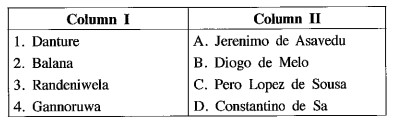
#21. The places where there were battles between the Kandyan rulers and the Portuguese are given in Column I. The names of the Portuguese Captain Generals who directed those battles are given in Column II. When the Column II is matched according to the sequence of Column I, what is the correct answer? Column I: 1. Danture, 2. Balana, 3. Randeniwela, 4. Gannoruwa. Column II: A. Jerenimo de Asavedu, B. Diogo de Melo, C. Pero Lopez de Sousa, D. Constantino de Sa.
1. Danture (1594) was against Pedro Lopes de Sousa (C). 2. Balana (1603) was against Jeronimo de Azevedo (A), although the Portuguese leader at Randeniwela is more fitting for the options. 3. Randeniwela (1630) was against Constantino de Sa (D). 4. Gannoruwa (1638) was against Diogo de Melo (B). The correct matching would be C, A, D, B. Option (4) provides C, D, A, B which seems to be the closest, though slightly reordered. Let’s re-examine: 1-C, 4-B. The question asks to match Col II to Col I. Let’s re-match. 1.Danture -> C.Pero Lopez de Sousa. 2.Balana -> A.Jeronimo de Azevedo. 3.Randeniwela -> D.Constantino de Sa. 4.Gannoruwa -> B.Diogo de Melo. The correct sequence of letters is C,A,D,B. None of the options match this exactly. However, let’s assume a common mistake in question setting. Option (4) is C, D, A, B. Let’s try matching this. 1.Danture->C.Correct. 2.Balana->D (Constantino de Sa). Incorrect. 3.Randeniwela->A (Azevedo). Incorrect. 4.Gannoruwa->B. Correct. Let’s try option (3). 1.Danture->C. Correct. 2.Balana->A. Correct. 3.Randeniwela->D. Correct. 4.Gannoruwa->B. Correct. So the sequence C, A, D, B is the correct match. Option (3) is the correct answer.
#22. The significant feature of the policy followed by the Dutch when dealing with the Kandyan kings was
The Dutch East India Company (VOC) was fundamentally a commercial enterprise. Their entire policy in Sri Lanka, and their relationship with the Kandyan Kingdom, was dictated by the goal of maximizing economic profit, primarily through the monopoly of the highly lucrative cinnamon trade. All other considerations, whether military, religious, or political, were secondary to this overriding economic objective.
#23. Some pairs of statements are given below under A, B, C and D. Examine the connections between the first and the second inclinations and answer the questions from 23 to 26.
A: 1. Attacking Bastille, 2. French Revolution.
B: 1. George Washington, 2. American Revolution.
C: 1. Administration of Tsars, 2. Russian Revolution.
D: 1. Dropping atomic bombs, 2. World War-I
: The pair of statement which indicates that influence of the second one contributes to the fall of the first one.
The oppressive, autocratic, and inefficient administration of the Tsars (C-1) created widespread discontent among the Russian people. This discontent was the primary cause of the Russian Revolution (C-2), which ultimately led to the fall and overthrow of the Tsarist administration.
#24. Some pairs of statements are given below under A, B, C and D. Examine the connections between the first and the second inclinations and answer the questions from 23 to 26.
A: 1. Attacking Bastille, 2. French Revolution.
B: 1. George Washington, 2. American Revolution.
C: 1. Administration of Tsars, 2. Russian Revolution.
D: 1. Dropping atomic bombs, 2. World War-I
: The pair of statement which points out that the function of the first one was the cause for the origin of the second one.
The storming of the Bastille prison on July 14, 1789 (A-1) was a symbolic and pivotal event that marked the beginning of the French Revolution (A-2). This act of defiance against royal authority galvanized the revolutionary movement and is considered the origin point of the revolution.
#25. Some pairs of statements are given below under A, B, C and D. Examine the connections between the first and the second inclinations and answer the questions from 23 to 26.
A: 1. Attacking Bastille, 2. French Revolution.
B: 1. George Washington, 2. American Revolution.
C: 1. Administration of Tsars, 2. Russian Revolution.
D: 1. Dropping atomic bombs, 2. World War-I
: The pair of statement which indicates that the contribution of the first one helps for the success of second one.
George Washington (B-1) was the commander-in-chief of the Continental Army during the American Revolution (B-2). His leadership, resilience, and strategic skill were absolutely crucial to the eventual military victory and success of the revolution.
#26. Some pairs of statements are given below under A, B, C and D. Examine the connections between the first and the second inclinations and answer the questions from 23 to 26.
A: 1. Attacking Bastille, 2. French Revolution.
B: 1. George Washington, 2. American Revolution.
C: 1. Administration of Tsars, 2. Russian Revolution.
D: 1. Dropping atomic bombs, 2. World War-I
: The pair of statement that does not indicate the relationship between the first one and second one.
The dropping of atomic bombs (D-1) occurred at the very end of World War II, not World War I (D-2). There is no direct causal or contributory relationship between these two events. In all other pairs, the first element is a cause, a part, a leader, or a consequence of the second element.
#27. Macadam method was used during the Industrial Revolution for
The Macadam method, invented by Scottish engineer John Loudon McAdam, was a revolutionary new technique for building roads. It involved creating a pavement of layered, compacted, smaller-sized stones, which was more durable and better for drainage. This method was widely adopted during the Industrial Revolution to improve the road network necessary for transporting goods.
#28. From the results of the industrialization stated below, what is the answer which indicates the changes that took place in the field of economics. : A – begining of the environmental pollution, B – speeding the production of commodities, C – expansion of the urbanization, D – expansion of slums and huts
Economics is concerned with the production, distribution, and consumption of goods and services. The Industrial Revolution, with its new machinery and factory systems, led to a massive increase in the volume and speed of production of commodities (B). This is a purely economic change. The other options refer to social (C, D) and environmental (A) consequences.
#29. Out of the following statements, what is the answer which includes the statements related to Governor Fredrick North. : A – getting the assistance of a Civil servant, John D’Oyly, B – proclaiming prince Muttusami as the king of Kandy, C – invading Kandy under the leadership of General Mc Dowell, D – abolishing the right of the throne of Udarata which the king and his relatives had
Frederick North was the first British governor of Ceylon (1798–1805). During his tenure, he became involved in Kandyan succession politics, at one point proclaiming Prince Muttusami (B) as the rightful king in opposition to Sri Vikrama Rajasinha. To enforce this, he launched an invasion of Kandy in 1803 under the command of General Hay MacDowall (C). This expedition ended in a disastrous retreat for the British.
#30. Few pairs of statements with reference to the religious and cultural revival of Sri Lanka in the 19th century are given below. Out of them, what is the pair which is not-relevant?
This pair is not-relevant because the Vidyodaya Pirivena was founded by Ven. Hikkaduwe Sri Sumangala Thero, not Ven. Ratmalane Dhammaloka Thero. While Dhammaloka Thero was a great scholar of the same era, the founding of this specific, major institution is correctly attributed to Sumangala Thero. The other three pairs are all correct.
#31. With reference to the statements given below from A to D what is the answer which includes the correct information regarding Sir Ponnambalam Ramanathan? :
A – serving as the Principal of Zahira College in Colombo,
B – voicing for the Buddhists when the government imposed martial law to repress the Riots of 1915,
C – enlightening the society about the harmful nature of alcoholism through drama,
D – pioneering to establish Sri Lanka National Congress.
Sir Ponnambalam Ramanathan was a towering figure in the late 19th and early 20th century. He courageously voiced for the fair treatment of the Sinhalese Buddhists who were arrested under martial law during the 1915 riots (B). He was also a key leader in the early nationalist movement and was instrumental in the establishment of the Ceylon National Congress (D), although he later left it.
#32. What is the incorrect information regarding the kingdom of Jaffna?
This statement is incorrect. While the Portuguese were obsessed with cinnamon, Jaffna was not famous for its cultivation. The cinnamon lands were primarily in the southwest of the island. The Portuguese attention was directed to Jaffna for strategic reasons, its political independence, its control over the pearl fisheries, and its role in regional politics.
#33. Which answer includes the title names sequently from among the title names given below from A to D, that were abolished in functioning the Soulbury Constitution and Constitutional Reforms of 1978? :
A – The Governor,
B – The Governor General,
C – Nominal Executive President,
D – Executive President
The Soulbury Constitution (which functioned until 1972) had a Governor-General (B) as the head of state, representing the British monarch. The 1972 constitution replaced this with a nominal Executive President (C). The 1978 constitution abolished the nominal presidency and created a powerful Executive President (D). Therefore, the offices of Governor-General (B) and nominal Executive President (C) were abolished in the transitions involving the Soulbury and 1978 reforms.
#34. Which answer contains a reform introduced to this country by the Soulbury Constitution?
The Soulbury Constitution, which granted independence to Ceylon in 1947, was modeled on the Westminster system. Its key feature was the introduction of a parliamentary system of government (3), with a Prime Minister and a cabinet responsible to a bicameral legislature. The other features listed (State Council, Universal Franchise, Executive Committee) were all part of the Donoughmore Constitution which the Soulbury constitution replaced.
#35. What is the oldest political party of Sri Lanka out of the following?
The Lanka Sama Samaja Party (LSSP) was founded on 21 December 1935. This makes it the oldest modern political party in Sri Lanka. The Communist Party was formed in 1943, the UNP in 1946, and the SLFP in 1951.
#36. During the administration of which Prime Minister the following reforms were functioned?
• making Sinhala as the state language
• nationalizing, the port and the Bus service
• upgrading the Vidyodaya and Vidyalankara pirivenas to universities
All three of these landmark reforms were carried out during the administration of Prime Minister S.W.R.D. Bandaranaike between 1956 and 1959. The “Sinhala Only Act” was passed in 1956, the nationalization of port and bus services took place in 1957-58, and the two great pirivenas were granted university status in 1959.
#37. Few information regarding the development activities of Sri Lanka are given under A, B, C and D below. Answer the questions 37 and 38 with reference to those information.
A – Using for paddy cultivation the lands existing in the dry zone which were not utilized so far.
B – Expediting the production of electricity to cover the increasing demand for electricity.
C – Giving lands which were owned by the Government, for large scale projects.
D – Strengthning the national economy by expanding the plantation crops furthermore.
: According to the above statements what is the letter which includes the main objective of establishing farming settlements?
Farming settlements, or agricultural colonization schemes, are specifically designed to bring new or underutilized land under cultivation. Their primary objective is to settle people on previously uncultivated land, particularly in the Dry Zone, and have them use it for paddy cultivation (A), thereby increasing food production and relieving population pressure elsewhere.
#38. Few information regarding the development activities of Sri Lanka are given under A, B, C and D below. Answer the questions 37 and 38 with reference to those information.
A – Using for paddy cultivation the lands existing in the dry zone which were not utilized so far.
B – Expediting the production of electricity to cover the increasing demand for electricity.
C – Giving lands which were owned by the Government, for large scale projects.
D – Strengthning the national economy by expanding the plantation crops furthermore.
: The letter which includes an expected objective from the multi-purpose development project is
Multi-purpose development projects, such as the Mahaweli Development Project, are designed with several objectives. A key and primary objective of these large-scale dam and reservoir projects is the generation of hydroelectric power to meet the country’s increasing demand for electricity (B). They also have irrigation and settlement objectives (A).
#39. What is the historical incident which is related to the ‘oaths in the tennis court’ and the States General Council?
Both the “oath in the tennis court” and the summoning of the “Estates-General” (States General Council) are pivotal events from the early stages of the French Revolution in 1789. The Estates-General was the assembly of the three social orders, and the Tennis Court Oath was the pledge taken by the Third Estate members after they were locked out, marking a key revolutionary step.
#40. The institution belongs to the United Nations Organization which has got the responsibility of imposing economic restrictions for keeping the international peace and security is
According to Chapter VII of the United Nations Charter, the Security Council has the power to take measures to maintain or restore international peace and security. These measures can include non-military actions such as imposing economic sanctions, arms embargoes, and financial restrictions on a country that is deemed a threat to peace.
