
Results


#1. What is the educational institution that Ven. Mahanama who wrote the early part of Mahāvamsa lived?
According to the Mahavamsa itself, its author, the venerable monk Mahanama, resided at the Dighasanda Senapati Pirivena (Diksanda Seneviya Pirivena) in Anuradhapura. This information is provided within the text, making it the correct location.
#2. What is the era that writing of inscriptions including historical information started in Sri Lanka?
The writing of inscriptions in Sri Lanka began with the introduction of the Brahmi script, which occurred around the 3rd century BCE. This period, marked by the arrival of Buddhism and the beginning of written records, is defined as the Early Historic era.
#3. What is the name used to identify the letters used in the early inscriptions of Anuradhapura period?
The earliest inscriptions found in Sri Lanka, dating from the 3rd century BCE onwards, are written in the Brahmi script. This script was adapted to write the early form of the Sinhala language. It is the foundational script from which later Sinhala scripts evolved.

#4. The names of inscriptions that include various laws which the kings have passed to make the people aware of are given in Column I and the information included in those inscriptions are given in Column II. When Column II is matched according to the order of Column I what is the correct answer?
1. Vevelketiya inscription (C) deals with judicial activities and criminal law in villages. 2. Badulla Pillar inscription (B) outlines detailed rules for a market town. 3. Godavāya inscription (A) records the donation of custom duties from the Godavaya harbour to a nearby temple. The correct sequence is C, B, A.
#5. Cave inscriptions or the Rock inscriptions mostly denote,
The vast majority of the earliest Brahmi inscriptions found on rock surfaces and cave drip-ledges are donative records. They typically state the name of the donor (the individual, who could be a chief, a merchant, or a commoner) and declare that the cave has been prepared and donated to the Buddhist Sangha (monastic community).
#6. From among the following, select the reason for Sri Lanka to develop an identical culture, although it was subjugated to various foreign influences?
Sri Lanka’s proximity to the Indian subcontinent has been the single most dominant factor in shaping its culture. This closeness facilitated the initial waves of migration, the introduction of Buddhism, the arrival of Hinduism, and the continuous flow of cultural, linguistic, and religious ideas from India, which formed the bedrock of Sri Lanka’s “identical” or foundational culture, despite later influences.
#7. What is the approximate number of years that is assumed from today to say that the Homosapian human beings lived in Sri Lanka?
Archaeological evidence from sites like Fa Hien Lena (Pahiyangala) has yielded skeletal remains of anatomically modern humans (Homo sapiens) that have been dated to approximately 38,000 years ago. This makes it one of the most widely accepted and scientifically established dates for early human presence on the island.
#8. What is the identification name given in ancient Eastern countries to the ruler who was elected by the consensus of the majority?
‘Mahāsammata’ (the Great Elect) is a concept found in Buddhist political thought, particularly in the Aggañña Sutta. It refers to the first king, who was chosen by the consensus of the people to maintain order and justice in society. This idea of a ruler elected by the people was an important concept of kingship in ancient Eastern countries influenced by Buddhism.
#9. During which era did colonies expanded centering village tanks in dry.zone?
The expansion of settlements based on village tanks (gam-wewa) is a defining characteristic of the Early Historic era in Sri Lanka’s Dry Zone (from c. 250 BCE onwards). This new technology allowed people to move away from the main rivers and establish agricultural communities throughout the region, leading to a significant expansion of colonies.
#10. The livelyhood that followed by the people who lived in settlements expanded in the areas away from the river valleys during Early Historic era was
The development of village tanks during the Early Historic era was for one primary purpose: to store water for paddy cultivation. This allowed people to establish settlements away from the perennial rivers and engage in wet-rice or “muddy field farming,” which became the backbone of the ancient Sri Lankan economy and civilization.
#11. The first ruler who transformed the political power of the Parumukas’ into a centralized system of Government was
King Dutugemunu (2nd century BCE) is credited with unifying the island under one rule. In doing so, he took the disparate power of the local chieftains (Parumukas), many of whom were his allies and generals, and integrated them into a single, centralized administrative structure under his command. This marked a crucial step in transforming fragmented local power into a unified state.
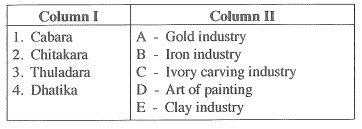
#12. The names used to identify the Artists who were engaged in various trades in the society in ancient Sri Lanka are given in Column I and their specific trades are given in Column II. When Column II is matched according to the order of Column I what is the correct answer?
1. Cabara refers to an iron worker or blacksmith (B). 2. Chitakara refers to a painter or artist (D). 3. Thuladara refers to a goldsmith (A). 4. Dhatika refers to an ivory carver (C). The correct sequence is B, D, A, C.
#13. What is the name used to identify the colonies established around harbours in ancient Sri Lanka?
‘Pattana’ is the ancient term for a port or coastal market town. Therefore, ‘Pattānagāma’ refers to a settlement or village associated with a port. These were the colonies established around harbours for trade and commerce. The other terms refer to fishing villages (Kewattagama), gem-worker villages (Manikaragama), and farming villages (Kasikaragama).
#14. What is the technological invention that was designed in Sri Lanka and considered to have expanded in South Asia?
The ‘Bisokotuwa’ or Sluice Gate of ancient Sri Lankan reservoirs is a unique and highly advanced technological invention. This device, which allowed for the controlled release of water while regulating pressure, was a key innovation that enabled the construction of massive reservoirs. It is considered a unique Sri Lankan contribution to hydraulic engineering that may have influenced technology elsewhere. The stupa is a pan-Buddhist architectural form.
#15. During the reign of king Nissankamalla the ‘Gautakanu’ were erected to show
‘Gautakanu’ or ‘Gavu Kanu’ were ancient milestones. They were placed along major roads to indicate distance, with each ‘gavu’ being a unit of measurement of approximately four miles. King Nissankamalla is known to have erected many of these along the main routes leading from his capital, Polonnaruwa.
#16. What is the tank where the Sluice Gate/Sluice of it is conserved as an ancient irrigation construction that consists very special technological knowledge?
The ancient sluice gate at the Maduru Oya reservoir is a remarkable feat of engineering. Discovered during the construction of the modern Maduru Oya dam, the ancient sluice shows a highly sophisticated design and construction, and it is exceptionally well-preserved. It is considered a prime example of the special technological knowledge of ancient Sri Lankan irrigation engineers.
#17. What is the answer that includes the two correct statements from among the following given under A, B, C and D with regard to king Vasabha. : A – Building up of the first tank under royal patronage, B – Liberating the country from Chola domination, C – Being the initial ruler who belonged to the Lambakarna dynasty, D – Formalization of the internal administrative system and the systematization of the collection of taxes.
King Vasabha (67-111 AD) was the founder and first ruler of the Lambakarna dynasty (C). He is also credited with being a great administrator who formalized the internal administrative system and systematized tax collection to fund his extensive construction projects (D). Liberating the country from Cholas (B) was done by Vijayabahu I. Building the first tank (A) was done by Pandukabhaya.
#18. From among the following what is the incorrect statement regarding the Polonnaruwa Period.
Mahatittha (modern Mantai) was the main port of Sri Lanka during the Anuradhapura period. During the Polonnaruwa period, while it was still used, the main ports had shifted south and east. The statement that it was the “main harbour” during the Polonnaruwa period is incorrect. The other three statements are historically accurate.
#19. After king Nissankamalla, the woman who represented the Pandyan family at the struggle for the crown that took place between the royal families of Kalinga and Pandya was,
After the death of Nissankamalla (of the Kalinga dynasty), a power struggle ensued. The Pandyan faction at court put forward Queen Kalyanawati as their claimant to the throne. She ruled briefly around 1202 AD, representing the Pandyan interest against the Kalinga faction. Lilawati represented the lineage of Parakramabahu I.

#20. Names of ancient royal capitals of Sri Lanka are given in Column I and some incidents related to those capitals are given in Column II. When column II is matched according to the order of Column I what is the correct answer?
1. Yapahuwa (D) was invaded by the forces of the Pandyan general Arya Chakravarti who stole the Tooth Relic. 2. Kurunegala (C) was the capital where the Sinhala Jataka story book was compiled. 3. Gampola (A) was the capital when the Arab traveller Ibn Battuta visited. 4. Jaffna (B) was the target of a major military operation by the Portuguese under Philip de Olivera in 1619. The correct sequence is D, C, A, B. Let’s check the options. None match exactly. Let’s re-examine. 1-Yapahuwa: Famous for the Tooth Relic being there and its capture. So D fits. 2-Kurunegala: Famous for Jataka stories. C fits. 3-Gampola: Ibn Battuta’s visit. A fits. 4-Jaffna: Portuguese operations under de Olivera leading to its fall. B fits. The correct order is D-C-A-B. Let me check my matching of 1. Yapahuwa again. Yapahuwa (D) Arya Chakravarti invaded and took the Dalada. This is correct. Let’s check the given options again. (3) D B A C. 1-Yapahuwa->D. Correct. 2-Kurunegala->B. Incorrect. (4) D C A B. 1-Yapahuwa->D. Correct. 2-Kurunegala->C. Correct. 3-Gampola->A. Correct. 4-Jaffna->B. Correct. Therefore, option (4) is correct.
#21. What is the statement that is not related to the Jaffna kingdom?
The ruling dynasty of the independent Jaffna kingdom was the Arya Chakravarti dynasty. The ‘Nayakkars’ were the South Indian dynasty that ruled the Kandyan Kingdom from 1739 to 1815. Therefore, the statement that the Nayakkars ruled Jaffna is not related to the Jaffna kingdom.
#22. What is the reason for Sri Lanka to be considered as important at the power struggle in the region of Indian ocean, between the British and the French?
During the 18th-century global power struggle between Britain and France, control of the seas was paramount. The deep-water, all-weather natural harbour at Trincomalee was considered a vital strategic asset for controlling the Indian Ocean and protecting trade routes to India. The British captured the island from the Dutch primarily to secure this harbour and deny it to the French.
#23. The main reason for Kotte rulers to be unsuccessful in expelling the Portuguese from the Maritime Provinces of Sri Lanka was,
The Kotte Kingdom in the 16th century was plagued by internal divisions and power struggles. Rulers like Bhuvanekabahu VII and his brothers Mayadunne and Raigam Bandara were constantly in conflict. This disunity among the Kotte rulers was skillfully exploited by the Portuguese, who played one faction against another, preventing a united front from being formed to expel them.
#24. The individual who provided information through various means to Governor Brownrigg in order to subjugate the Kandyan kingdom in 1815 A.D. was,
John D’Oyly was a British civil servant who mastered the Sinhala language and the intricacies of Kandyan court politics. He acted as the chief intelligence officer and translator for Governor Robert Brownrigg. He cultivated relationships with disgruntled Kandyan chiefs, like Ehelepola, and provided the crucial information and diplomatic maneuvering that enabled the British to take over the kingdom with minimal resistance.

#25. Arrange Column II in accordance with the order of the concepts given in Column I and select the correct answer from among the following.
1. Socialism (B) is an ideology based on common ownership or rights to the wealth of society. 2. Capitalism (A) is an economic system focused on private ownership and earning maximum profit through capital investments. 3. Laissez-Faire (C) is a doctrine advocating for minimal government interference in economic affairs. The correct sequence is B, A, C.
#26. The most important change that occurred in the political field during the Renaissance in Europe was
During the Renaissance, feudalism declined and powerful, centralized monarchies consolidated their power over defined territories with common languages and cultures. This process led to the decline of fragmented provincial states ruled by nobles and the emergence of modern nation-states, such as England, France, and Spain, which is the most significant political change of the era.
#27. From among the following, for what reason John Wycliff, John Huss, Irrasmus and Matrin Luther became famous individuals?
All four individuals—Wycliffe, Huss, Erasmus, and Luther—were key figures in the movement for religious reform that culminated in the Protestant Reformation. They became famous for their scholarly and theological critiques of the doctrines, practices, and corruption within the Roman Catholic Church of their time.
#28. What is identified by the term ‘Paravenigam’ during the Kandyan period?
‘Paraveni’ land was a form of hereditary tenure. It was land that was held by a family and passed down through generations. The villagers had strong, ancestral rights to occupy and cultivate this land, as long as they performed the required services (rajakariya) to the king or the local lord. It was essentially land occupied by villagers for generations.
#29. From among the following what is the statement that includes the meaning of the principle of “People’s Sovereignty”?
People’s Sovereignty is the principle that the ultimate authority of the state resides in the people. The most direct expression of this sovereignty is the people’s right to choose their government and rulers (through elections) and to remove them if they lose the people’s confidence.
#30. Answer questions 30 and 31 using following information given from A-E.
A – The termination of the trading monopoly of the state,
B – Bi-cameral Parliament,
C – The King/Queen of Great Britain terminated the state leadership in Sri Lanka,
D – The Executive Presidency,
E – The establishment of the Post of Ombudsman
: What is the answer that includes the information on 1948 Soulbery Constitution and 1972 Republican Constitution.
The Soulbury Constitution of 1948 established a bicameral (two-chamber) Parliament (B), which included a Senate and a House of Representatives. The Republican Constitution of 1972 terminated the position of the British monarch (King/Queen of Great Britain) as the head of state of Sri Lanka (C), replacing it with a President.
#31. Answer questions 30 and 31 using following information given from A-E.
A – The termination of the trading monopoly of the state,
B – Bi-cameral Parliament,
C – The King/Queen of Great Britain terminated the state leadership in Sri Lanka,
D – The Executive Presidency,
E – The establishment of the Post of Ombudsman
: What is the answer that includes information on the new constitution of 1978?
The Constitution of 1978 introduced two key features from the list: the powerful Executive Presidency (D) as the head of state and government, and the post of the Ombudsman (E) or Parliamentary Commissioner for Administration, to investigate citizens’ grievances against the government.

#32. Answer question No. 32 using the information given in the following table. What is the answer that contains information related to the First World War?
The First World War involved Germany (B). A key incident that drew the USA into the war was the sinking of the passenger ship Lusitania by a German submarine (C). A major result of the war was the creation of the League of Nations, proposed by US President Woodrow Wilson (E). Therefore, B, C, and E are all related to WWI.
#33. From among the following what is the decisive factor that influenced to conclude the World War II?
The atomic bomb attacks on Hiroshima and Nagasaki in August 1945 were the decisive final act of World War II. The unprecedented devastation caused by these new weapons led to Japan’s unconditional surrender a few days later, bringing the war to a conclusion.
#34. The conference that was fundamental to prepare the Charter of the United Nations Organization was
The United Nations Conference on International Organization, commonly known as the San Francisco Conference, was the convention of delegates from 50 Allied nations that took place from April to June 1945. It was at this conference that the final text of the United Nations Charter was drafted and agreed upon, fundamentally preparing the organization’s founding document.
#35. Answer question 35 using the statement given under A and B.
A – “No taxation without representation.”
B – “The history will not excuse us if we do not get hold of power at this moment.”
: With regard to the American war of independence
Statement A, “No taxation without representation,” was the central slogan and ideological justification for the American war of independence. Statement B is a famous quote from Vladimir Lenin on the eve of the Russian Revolution in 1917. Therefore, with regard to the American war, A is true and B is not true.
#36. From among the following, what is the incorrect statement with regard to the Russian Revolution?
This statement is incorrect. Pre-revolutionary Russia had a predominantly agrarian and semi-feudal economy. While capitalism was developing in some sectors, it was far from being the prevailing system. The economy was largely underdeveloped and not characterized by a widespread capitalist system. The other statements are all correct.

#37. Under A, B, C and D are given couples of statements. Examine the relationship between the statements given as one and two, and answer the questions from 37 – 39.
The second statement influence to expand the activity of what is given in statement one.
The Cold War (A-1) was a period of intense rivalry and mistrust between the superpowers. This led to a massive expansion of intelligence gathering and covert operations. Spy services (A-2) like the CIA and KGB became crucial tools in the Cold War, and their activities were expanded and influenced by the ongoing conflict.
#38. Under A, B, C and D are given couples of statements. Examine the relationship between the statements given as one and two, and answer the questions from 37 – 39.
: The couple of statements does not show any relation between the two
The Non-Alignment conference (B-1) was a movement of states that chose not to formally align with or against any major power bloc. Winston Churchill (B-2) was a British Prime Minister and a key figure in the Western bloc during the Cold War. While he was aware of the Non-Aligned Movement, there is no direct causal or functional relationship between the two in the same way as in the other pairs.
#39. Under A, B, C and D are given couples of statements. Examine the relationship between the statements given as one and two, and answer the questions from 37 – 39.
: The second statement influence to the downfall of what is given in statement one
The Jews (C-1) were the primary victims of the Nazi regime. The Nazi Troops (C-2), particularly the SS and Einsatzgruppen, were the instruments used to carry out the persecution and genocide of the Jews, leading to their downfall and murder in the Holocaust.
#40. The world leader who received the attraction of the world for nationalizing the Suez canal and the assistance given to formulate the non-aligned organization is
Gamal Abdel Nasser, the President of Egypt, gained massive international attention and prestige in the Arab and developing world for his bold nationalization of the Suez Canal in 1956. He was also one of the three core founders of the Non-Aligned Movement, along with Nehru of India and Tito of Yugoslavia, and was instrumental in formulating its principles.
